October 24-25 (Friday-Saturday), Raleigh NC and Online
All 15 lectures along with other activities will be held in-person in Raleigh on October 24 and 25. All lectures as well as the Welcome sessions will be streamed live for online attendees. All lectures will be recorded and along with bonus recordings will be available for everyone registered to view at your leisure until December 31, 2025. Note that the optional workshops and the Trivia Quiz are designed for in-person attendees and will not be streamed or recorded.
All times listed are Eastern Time.
SCHEDULE AT A GLANCE – SCROLL DOWN FOR DETAILED LECTURE DESCRIPTIONS
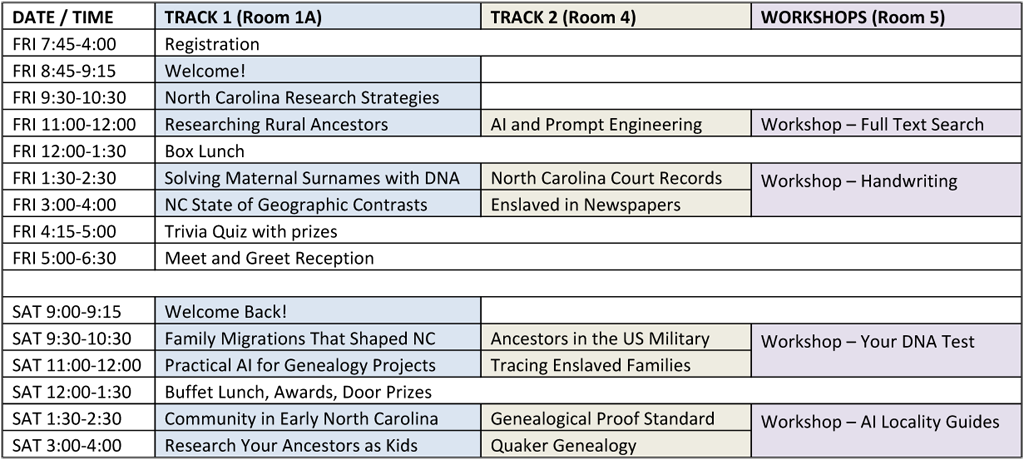
Bonus lectures available after the conference: Lineage Societies, Guardianship Records, Divorce Records
TUESDAY – THURSDAY, OCTOBER 21-23
There are currently no formal pre-conference activities scheduled. However, if you are researching North Carolina ancestry we encourage you to take time to visit the State Archives and the State Library of NC in Raleigh – both in the same building! There are also research facilities nearby in Chapel Hill. For more information see Research .
FRIDAY, OCTOBER 24
Welcome!
Friday 8:45 AM to 9:15 AM
In addition to going over how to navigate the conference, we’ll talk a little about North Carolina genealogy and the North Carolina Genealogical Society.
Keynote address: North Carolina Research Strategies: A Blueprint for Discovery
Friday 9:30 AM to 10:30 AM (All tracks) – J. Mark Lowe, FUGA
Uncover the unique challenges and hidden opportunities in North Carolina genealogy. This session delves into state-specific research quirks—from shifting county lines and evolving surnames to underused records like bastardy bonds, slave deeds, land entry books, and taxables. Learn how to navigate these resources to break through brick walls and build a focused, effective research roadmap.
Sources for Researching Rural Ancestors
Friday 11:00 AM to 12:00 PM (Track 1) – Ari Wilkins, FTxSGS
If you blink, you’ll miss it! Did your ancestor come from an one-horse town or an unincorporated community? Learn about researching country ancestors!
This lecture will discuss a variety of sources and methodologies for researching rural communities. It will cover census records (including population, agricultural and school censuses); church and cemetery records; court records; maps (including census enumeration maps, postal route maps, and cadastral maps); newspapers; property records (including deed and homestead records); rural directories; manuscript collections.
Ancestors, AI and Prompt Engineering
Friday 11:00 AM to 12:00 PM (Track 2) – Margaret M. McMahon, Ph.D
This presentation explores how Artificial Intelligence (AI) supports genealogical research for all experience levels. Learn the fundamentals of using AI chat tools, how to build effective prompts, explore other helpful AI tools, and understand the limitations. Whether you are getting ready to begin using generative AI or want to expand your current use, gain practical strategies and ideas to enhance your research process and integrate AI more confidently into your genealogy toolkit.
Workshop: Using FamilySearch Full Text Search (Extra cost, in-person only)
Friday 11:00 AM to 12:00 PM (Workshop) – Michele Doyle
This one hour workshop will introduce participants to FamilySearch’s Full Text Search feature. Attendees will learn how to use the interface and how to use search terms. Participants will use FS Full Text to possibly locate ancestors in digitized books, court records, land deeds, and other primary sources not indexed in standard searches. This session will help researchers to uncover valuable information previously buried in unindexed text, helping break through brick walls in family trees.
IMPORTANT: You must bring a laptop in order to complete in-class assignments.
Lunch Break
Friday 12:00 PM to 1:30 PM (All tracks) – Box lunch, extra cost
There are no lectures scheduled during this time. We encourage you to socialize with your fellow researchers, and visit our Resources Room.
Filling in Those Pesky Blanks: Solving Maternal Surname Mysteries with DNA
Friday 1:30 PM to 2:30 PM (Track 1) – Kate Penney Howard
We all have that ancestor with a first name, but no family name. When traditional genealogical techniques fail to turn up an answer, we can turn to DNA to find more opportunities to discover clues.
Finding and Understanding North Carolina Court Records
Friday 1:30 PM to 2:30 PM (Track 2) – David M. McCorkle
Your ancestor did not have to be a criminal to appear in court records! Courts handled the expected lawsuits and criminal prosecution, but prior to 1868 the county courts also acted as the local government handling taxes, probate, land purchases, public buildings, roads, orphans, the poor, coroners, schools, and more.
Workshop: What in the World Does That Say? Overcoming Difficult Handwriting (Extra cost, in-person only)
Friday 1:30 PM to 4:00 PM (Workshop) – Pam Vestal
One of the biggest hurdles in genealogy is the challenging handwriting in the records. Whether you struggle with colonial penmanship that doesn’t even look like English or a letter written yesterday, we’ll consider more than 20 techniques to help you figure out what the chicken scratches on the page say.
From Colony to Cradle: NC State of Geographic Contrasts
Friday 3:00 PM to 4:00 PM (Track 1) – J. Mark Lowe, FUGA
Learn how North Carolina’s physical geography dictated community development, transportation, and cultural divides, revealing why “east vs. west” has long defined NC politics and identity. We will learn how these shaped settlement, agriculture, and economic life. We will follow early settlement routes—Native trails, Moravian paths, and wagon roads—and how population clusters formed along waterways, trade lines, and land grants.
Tracing the Enslaved in Newspapers
Friday 3:00 PM to 4:00 PM (Track 2) – Ari Wilkins, FTxSGS
When tracing enslaved and formerly enslaved people, valuable and descriptive information can be gathered from newspapers. This lecture will discuss how to search for African Americans in newspapers; information that can be gleaned from advertisements; how newspapers can lead you to other sources; different types of newspapers; and discerning the political slant of newspapers. It will also talk about: researching newspaper databases; creating effective search terms, and researching newspapers that have not been digitized.
Trivia Quiz: Genealogy, NC history, and NC trivia (In Person only)
Friday 4:15 PM to 5:00 PM – David M. McCorkle
Test your knowledge of genealogy, NC history, and NC trivia! This quiz is designed not only to test your knowledge, but also for learning about obscure, useful, and even fun information about genealogy, history, and the State of NC. We will keep score for those interested (there will be prizes!), but it will be set up so you can just drop in and listen. David has been presenting these popular quizzes at his county genealogical society’s annual celebration party for almost 10 years. We tried it last year and it was well received, so let’s do it again!
Example: A cadastral map shows what?
A. Location of waterways
B. Property owners
C. State and county boundaries
D. Terrain
“Meet and Greet” Reception
Friday 5:00 PM to 6:30 PM
Join NCGS staff, conference speakers, and your fellow genealogists for an informal gathering at the McKimmon Center. Light food will be provided.
Saturday, October 25
Welcome Back!
SATURDAY 9:00 AM to 9:15 AM
A quick overview of the day
Founding Footsteps: Family Migrations That Shaped North Carolina
Saturday 9:30 AM to 10:30 AM (Track 1) – J. Mark Lowe, FUGA
This session explores North Carolina’s transformation from a vulnerable coastal colony to a central pillar of Southern identity through the lens of four families whose movements and generational footprints illuminate broader patterns of migration, settlement, and regional development. By tracing these family lines, we uncover how individual lives contributed to the shaping of the state’s historical and cultural landscape.
Crash Course on Researching Ancestors in the US Military
Saturday 9:30 AM to 10:30 AM (Track 2) – Margaret M. McMahon, Ph.D
Learn strategies for researching the US military service of your ancestors using online databases, archives, repositories, and social networking. Discover how to overcome the challenge of burned personnel records using alternative sources. This presentation also includes information about how to use military archives in your research, and offers ideas about sharing your ancestors’ military stories with others.
Workshop: Using Your DNA Test with Your Genealogy (Extra cost, in-person only)
Saturday 9:30 AM to 12:0 PM (Workshop) – Kate Penney Howard
Bring your laptop and walk through methods to work with your matches. You will learn the vocabulary you will need, tools you can use, and methods that will help you identify your matches, help solve mysteries, and reunite with long-lost family.
Practical AI for Genealogy Projects: From Images to Archives
Saturday 11:00 AM to 12:00 PM (Track 1) – Steve Little
This presentation equips intermediate genealogists with practical AI techniques for two high-value projects: gravestone documentation with image analysis and historical publication indexing with text processing. Participants will master structured prompting, collaborative AI workflows, and advanced features while creating useful research assets.
Tracing Enslaved Families: Using Court and Estate Records
Saturday 11:00 AM to 12:00 PM (Track 2) – Ayo Heinegg Magwood
Learn how to trace enslaved ancestors through court and estate records—wills, inventories, sales, and equity cases. Discover practical strategies and real examples from the forthcoming article “Tracing an African American Family Lineage from the 17th to the 20th Century: The Kee Family of Northampton County, NC” in The Genealogist.
Lunch Break + Awards Ceremony + Door Prizes
Saturday 12:00 PM to 1:30 PM (All tracks) – Buffet lunch, extra cost
Saturday lunch is more than just eating and socializing. Each year, the North Carolina Genealogical Society honors worthy individual and society endeavors in publishing and other contributions to North Carolina genealogy. Awards winners for 2025 will be recognized and will receive their plaques. If you are interested in nominating someone for an award, please see our awards page. Deadline is August 31, 2025. We will also be giving out door prizes to the lucky winners!
Viewing A Whole Community in Early North Carolina
Saturday 1:30 PM to 2:30 PM (Track 1) – J. Mark Lowe, FUGA
To truly understand an ancestor’s world, we must look beyond the individual and view the entire community. This session focuses on how to piece together early North Carolina neighborhoods by layering maps, deeds, and tax lists. By integrating additional resources—such as road orders, ferry licenses, mill locations, cemetery surveys, and historic structures—we can reconstruct the social and economic networks that shaped daily life. Discover how to trace not just where people lived, but how they lived, moved, worshipped, and worked alongside their neighbors.
Elements for Sound Research: A Guide to Applying the Genealogical Proof Standard
Saturday 1:30 PM to 2:30 PM (Track 2) – Cheri Hudson Passey
Intimidated by the Genealogical Proof Standard (GPS)? This session will help you understand each of the 5 elements and create a solid foundation for your research.
Workshop: Creating North Carolina Local and Regional Locality Guides using ChatGPT and Spreadsheets (Extra cost, in-person only)
Saturday 1:30 PM to 4:00 PM (Workshop) – Jon Smith
This workshop will equip genealogists with the skills to construct detailed locality guides for towns or counties using ChatGPT, combining with other nearby locality guides into regional guides, using spreadsheet software such as Microsoft Excel or Google Sheets, with Catawba County used as the example location. These guides can serve as living documents for tracking repositories, records availability, historical boundary changes, migration patterns, and resource links.
Requirements: Students will need a computer, a free account with ChatGPT, and a spreadsheet program.
Tar Heel School Days: Research Your Ancestors as Kids
Saturday 3:00 PM to 4:00 PM (Track 1) – Diane L. Richard
Children can be challenging to research. They fall through the cracks of most federal records (except for the census). There are private and local government records that document youth (5-21 years old) – school records. Though public schools haven’t always existed, education-related records are available to researchers. They can help identify the children in a family and fill knowledge gaps before the 1850 census.
Quaker Genealogy
Saturday 3:00 PM to 4:00 PM (Track 2) – Elizabeth A. Saunders
Start with the basics of Quaker genealogy, including the types of records available and where to find them. Then dive deeper into how Quaker terms affect your ancestral research, like calendar changes and the huge difference between “disowned” and “condemned.” Learn how migration and preparative meetings affect where to find records, how to use extracts to find more detail in the original monthly meeting minutes, and how meeting histories can give context to your ancestors’ stories.
Bonus Recordings
Everyone registered for the conference will have access to 3 additional recorded lectures, available after the conference. You may watch them at any time up to December 31, 2025
Celebrate Your Ancestor in a Lineage Society
Gay H. Baynes
Does your ancestor qualify you to join a lineage society? Societies honor everything from the the Alamo to Witches! They honor the sons and daughters of the Military, African Americans, Farmers, Pirates, Colonists, Textile Workers, and Tavern Keepers. The presentation includes a review of American lineage societies, the benefits of joining, a detailed description of a typical application process, and the challenges of applying. Tips and a review of available public manuals provide guidance.
Divorce in the “Old North State” – Family Dynamics, FAN Club, and More!
Diane L. Richard
Divorce was heavily restricted until the early 1800s, making surviving petitions invaluable for research, especially in “burnt counties.” Though many divorces weren’t granted, the extant paperwork is priceless. Even with later laws, divorces weren’t automatic – pursuing the paper trail can reveal significant information about ancestors and their FAN club.
Someone to Watch Over Me: Guardianship Records
Cheri Hudson Passey
Learn how to use guardianship records for minors and others who needed to be “watched over” and understand the valuable genealogy information they contain.